
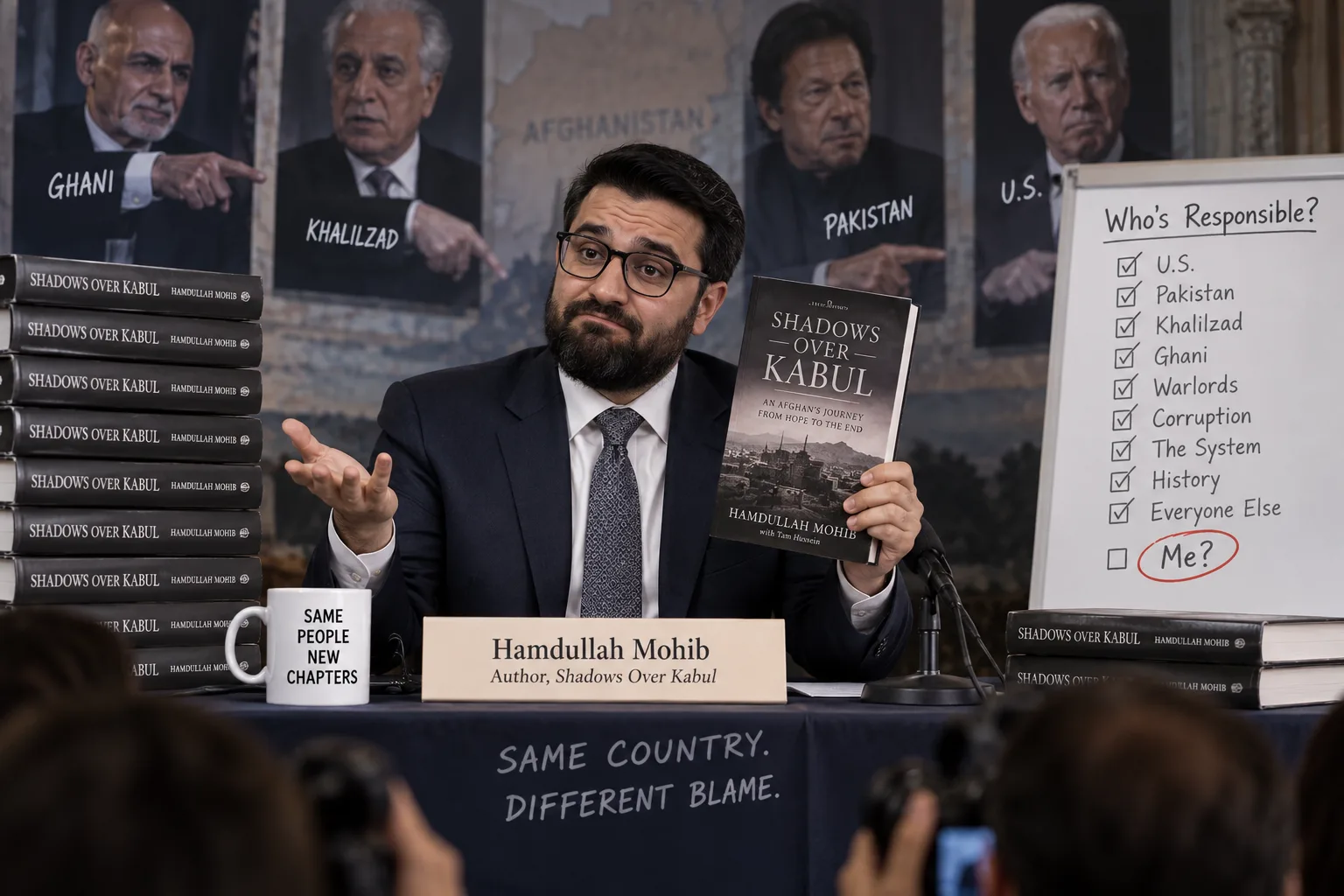
LONDON—Former Afghan National Security Adviser Hamdullah Mohib has published a 248-page account of the fall of the Afghan republic, concluding after extensive investigation that responsibility extended from Washington to Islamabad and Zalmay Khalilzad before mysteriously losing the trail somewhere near his own office.
*Shadows Over Kabul*, written with journalist Tam Hussein, recounts Mohib’s rise from Afghan ambassador in Washington to one of President Ashraf Ghani’s closest advisers and ultimately the national security official present as the country’s security architecture achieved its final operational objective of disappearing.
Mohib devotes particular attention to Khalilzad, whose negotiations with the Taliban he argues undermined the republic, as well as Pakistan, the prisoner release and Western policy.
Investigators praised the breakthrough, noting that Afghanistan’s collapse had remained difficult to explain because nearly every senior official involved had independently determined that another senior official was responsible.
Ashraf Ghani has blamed political betrayal and the circumstances surrounding the withdrawal. Khalilzad has defended the negotiations. Former officials have blamed Pakistan, America, the Taliban, corruption, warlords, Doha, each other and occasionally history itself.
Mohib’s contribution is expected to significantly narrow the list by confirming that Hamdullah Mohib was also there.
Publishers said the memoir offers readers a rare insider account of how a government with a president, national security adviser, defense ministry, interior ministry, intelligence service, parliament, international backing and twenty years of institution-building could collapse in days.
The answer, according to Kabul’s former insiders, continues to be other people.
Former Republic officials worldwide reportedly breathed a collective sigh of relief, thanking Mohib for becoming the first among them to put everything in writing.
“Twenty years, thousands of officials, billions of dollars—we were beginning to worry they might blame all of us,” one former minister said. “Then Hamdullah wrote a book.”
Former officials are now expected to spend the coming months honoring Mohib’s sacrifice on television, where they will solemnly explain that the only one responsible for the fall has finally confessed his sins.